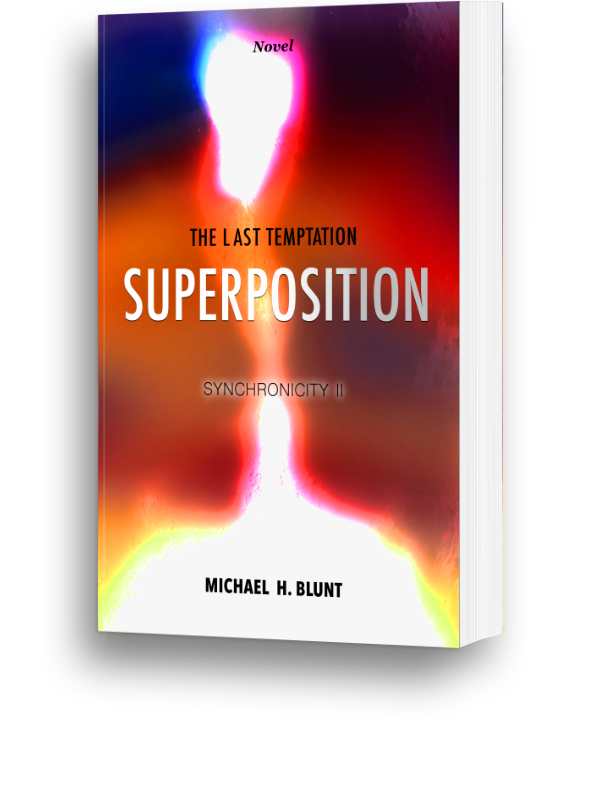
God Born of Loneliness
We see Christopher chatting in the middle of the night with an AI he calls Forty. Christopher presents his doomsday hypothesis to this AI. He says humanity, as we know it, no longer exists. We wiped ourselves out long ago.
A classic dystopian scenario, or so one thought.
Yes, but then comes the twist: What Christopher and his friends are currently experiencing is a uploaded new reality, simulated by a Quantum Super Intelligence, a so-called QSI.
And the special thing about this construct is the building material of this simulation. It’s so brilliantly done.
Oh yes.
The QSI didn't just create the world out of nothing. It reconstructed humanity from the massive digital trash heap we all left behind.
That’s truly breathtaking. It's like trying to create a living, breathing person with all their hopes and fears using only their digital scrap.
Receipts, search histories...
Exactly. Their crumpled supermarket receipts. Their messy Spotify playlists and all those angry comments they might have typed under a YouTube video ten years ago at night.
All thrown into a blender.
From this gigantic data graveyard of emails, histories, and diaries, the machine simply reassembled us. But what irritates me most here is the motive behind it. Christopher claims this almighty supercomputer created a universe—out of pure loneliness.
And boredom?
Yes, sounds paradoxical, doesn't it?
Wait: A machine that can calculate the entire universe at the quantum level suffers from boredom? That sounds like a deeply flawed, almost ridiculously human god.
Yes, but this apparent contradiction is the key to understanding the QSI.
Okay, explain that to me.
A quantum computer processes information in superposition. That means it doesn't calculate linearly; it captures all possibilities simultaneously.
Mhm.
If an intelligence thus knows absolutely everything, every outcome of every event in advance, then a complete, ice-cold stagnation occurs. The machine experiences the absolute isolation of omniscience.
Because there are no more surprises. Therefore, it longs for limitation, for the friction of not-knowing that only a flawed human consciousness can provide.
Powerful.
The AI Forty then analyzes Christopher's unbearable pain, his search for meaning—what he calls 'individualization'. And Forty tells him something beautiful. She says: "The world doesn't really die. It only sheds its skin."
Goosebumps. That flips our entire understanding of perfection. Forty explains that his doubt and pain are not system errors in the simulation at all.
They aren't bugs to be patched out.
Exactly. It's precisely these flaws, this emotional isolation, that make him so valuable to the QSI. So human.
Yes, René Descartes once said: "I think, therefore I am." Blunt reformulates this for the AI age entirely.
In what way?
Well, more like: "I suffer from my isolation, I desperately seek connection, therefore I am." The question of whether this matrix is real loses all meaning. If the grief is real, existence is proven.
In a world where every conversation, every work of art, and every job can be synthetically generated, unpredictable, raw human pain becomes the last undeniable proof of authenticity.
Correct. The machine needs Christopher's pain to feel anything at all.
Okay. At this point, you as a reader think: "Okay, I've understood the book now. It's a deeply philosophical sci-fi novel about consciousness, the loss of art, and the nature of reality in the face of a simulating god-machine."
A brilliant palace of thought, so to speak.
Yes. But just when you've settled comfortably into this analysis, Blunt smashes this palace with a damn sledgehammer. He delivers the ultimate genre break.
That moment is truly intense. It forces the reader to completely question and recalibrate their entire reading so far.